-
- Hook and context: introduction & why this Decree matters now
Few people realize that Vietnam is now ahead of many countries in the region when it comes to AI legislation. After the Artificial Intelligence Law No. 134/2025/QH15 was passed by the National Assembly at the end of 2025, Vietnam became the third country in the world to enact a comprehensive AI law — following only the EU and South Korea.
What is even more remarkable is that the government did not stop there. In less than five months from the date the AI Law took effect, a complete legal framework was put in place — from the law itself to detailed implementing regulations. And on 30 April 2026, the government officially issued Decree 142/2026/NĐ-CP (the “Decree”), which came into force immediately on 1 May 2026.
What does this pace tell us? This is not just another policy signal — it is a serious commitment to enforcement with a clear and concrete roadmap.
For companies that develop, provide, deploy or use AI systems, the Decree stipulates risk‑based obligations, transparency duties and documentation requirements that many organizations must start addressing immediately. Besides, the Decree sets out the sandbox mechanism as initiative to promote AI development and assigns the Ministry of Science and Technology (the “MIST”) to be the main management body of any AI related activities in Vietnam.
-
- What the Decree regulates
Decree clarifies several core elements of the AI Law, including:
- The scope and subjects: AI providers, developers, deployers, users and affected persons, both in Vietnam and foreign entities engaging in AI activities in Vietnam.
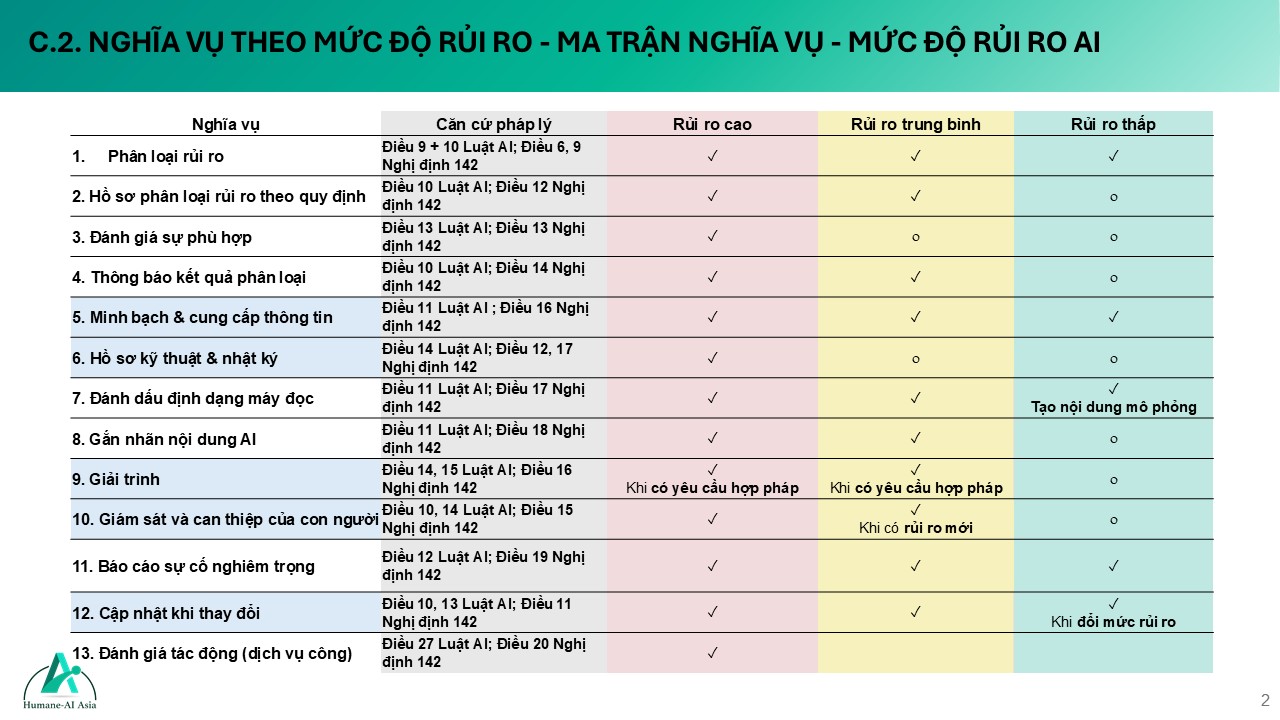
- The risk‑based regime: it sets principles (Art. 5), criteria and procedures for classifying AI systems into low, medium and high‑risk (Art. 6) and corresponding obligations such as conformity assessment, risk management and reporting.
- The national one‑stop AI portal and national AI system database: how risk classifications, incident reports and conformity assessments are notified and managed by the MIST.
- Immediate obligations for companies
- Identify your role(s) in the AI value chain
- Immediate obligations for companies
Because the Decree assigns different duties to providers, deployers and users at each step of the AI lifecycle , the first essential action should be a role mapping exercise: list your AI systems and, for each system, decide whether you act as developer, provider, deployer, user. The same organization may hold multiple roles for different systems.
-
-
- Classify AI systems, and ensure compliance with the corresponding obligations
-
According to the AI Law, before any AI system is put into use, the provider must classify its risk level. The Decree clarifies that: (i) [Art 6.1], providers classify AI systems before putting them into use; (ii) [Art 6.3], high-risk AI are those subject to the List of High-risk AI Systems per the Prime Minister Decision.
Deployers must re‑assess the risk classification when they significantly change the systems in ways that could increase risk.
For medium and high-risk AI systems, providers must create and keep a risk classification file that documents the system, its purpose, the data used, and the risk-management measures.
In addition, providers of medium and high-risk systems must notify the Ministry of Science and Technology of their risk classification results through the national AI portal before putting the system into use. The portal assigns a unique identification code to each AI system.
The Decree clearly requires the labeling and identification of AI-generated content. Providers and deployers are expected to implement technical measures, such as metadata and digital signatures, to enable users to recognize AI-generated audio, images, or videos, particularly synthetic or deepfake content that imitates real individuals.
-
-
- Obligations for high-risk systems
-
For high‑risk AI systems, providers must:
- Establish and maintain a risk management system for each high‑risk AI system, covering risk identification, mitigation, monitoring and updates.
- Prepare a technical file and system description that include system architecture, training data characteristics, model parameters and training conditions, performance evaluation, security controls and known limitations, to support conformity assessment and oversight.
- Conduct a conformity assessment, either through an accredited conformity assessment body or, in some cases, via internal assessment, and publicly disclose the conformity assessment result on the national AI portal.
Deployers of high‑risk systems must implement operational risk management, human oversight and incident response measures based on the provider’s guidance and the Decree’s requirements.
-
- Initiatives & sandbox mechanisms
The Decree also introduces several government support mechanisms to foster AI innovation. These include regulatory sandboxes that allow companies to test innovative AI solutions in controlled real-world environments with potential exemptions or adjustments to certain compliance obligations during the approved testing phase. In addition, eligible startups and SMEs may receive financial support through AI development vouchers, as well as facilitated access to national AI infrastructure and shared data resources for model training and testing.
-
- What businesses should do next
If a business is developing/ providing/ deploying/using or about to do so in Vietnam, here is a short list of actions:
- Build AI system inventory.
- Map roles and responsibilities.
- Classify risk levels.
- Create and maintain risk classification files.
- Plan upgrades for in-use systems: for AI systems in use before 1 March 2026, design a roadmap to reach full compliance before March 2027.
Organizations that act early will be more ready and at better position, not only for regulatory compliance but also for participation in national AI infrastructure, data initiatives and support mechanisms that the Decree envisions.
Connect with Humane-AI Asia to operationalize AI accountability and turn compliance into a foundation for responsible and sustainable innovation.
For more information about our services, visit: https://humane-ai.asia/en
Email: info@humane-ai.asia